Plant Care
What is the best way to propagate variegated plants, such as Monstera and Philodendron?
Apr
What Is the Best Way to Propagate Variegated Plants Such as Monstera and Philodendron?
Published by Variegated Plants Circle · variegatedplantscircle.com
Propagating variegated plants is one of the most rewarding skills a collector can develop — and one of the most nerve-wracking. When the plant you’re working with is a Monstera Albo worth hundreds of dollars or a Philodendron Caramel Marble that took months to source, the stakes feel very real.
The good news is that variegated aroids like Monstera and Philodendron are genuinely propagable by anyone willing to understand a few key principles. The bad news is that variegated propagation carries unique risks that don’t apply to regular green plants — particularly around variegation loss and chimeric instability — and most general propagation guides simply don’t address them.
This guide gives you everything: the best methods, the specific steps, the critical mistakes to avoid, and how to maximise the chance that the plant you propagate retains the spectacular variegation that made you want to propagate it in the first place.
Why Variegated Plant Propagation Is Different
Before getting into methods, it’s worth understanding what makes variegated propagation distinct from propagating regular houseplants.
The Chimeric Problem
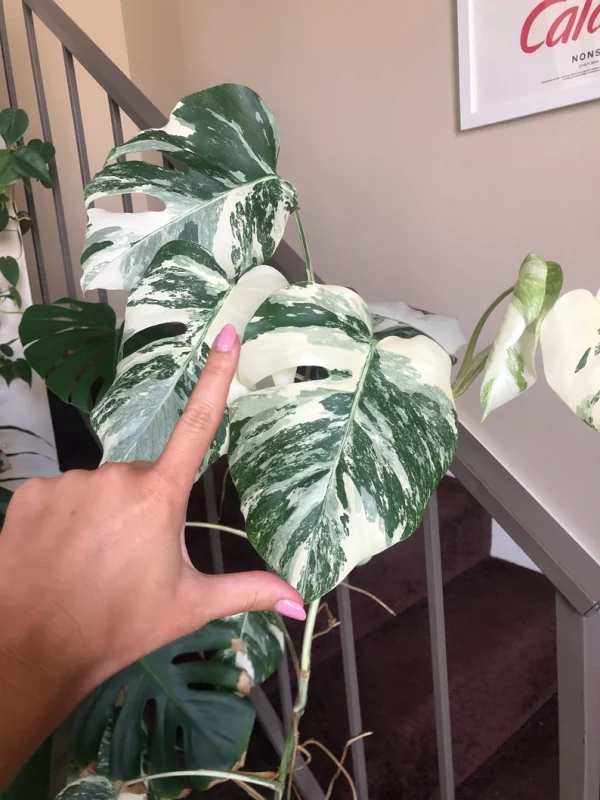
The most prized variegated plants — Monstera Albo Variegata, Philodendron Pink Princess, Monstera Mint Variegata — are chimeric. This means their variegation is not encoded in every cell of the plant. Instead, it exists in specific cell lineages that run through the plant’s growing tissue. Different sections of the stem carry different ratios of variegated to green cell lines.
When you take a cutting, you are essentially taking a sample of these cell lines. The cutting you take from a heavily variegated node may produce beautifully variegated new growth. A cutting from a more heavily green section of the same plant may produce predominantly green growth — even though it came from the same plant.
This is why node selection is the single most important decision in variegated propagation. It is not analogous to propagating a regular plant where any healthy cutting will produce a replica of the parent.
Tissue Culture Stable vs. Chimeric
Some variegated plants — including the Monstera Thai Constellation and most Aglaonema cultivars — have DNA-encoded variegation that is present in every cell. These propagate more predictably: any healthy cutting or offset will produce variegated offspring.
Understanding which type of variegation your plant has will set your expectations correctly before you begin.
The Four Main Propagation Methods for Variegated Aroids
Method 1: Stem Cutting with Node (The Gold Standard)
This is the most reliable and most widely used propagation method for Monstera and Philodendron. It produces the fastest results and, when executed well, the highest chance of maintaining strong variegation.
What you need:
- A healthy stem cutting containing at least one node
- Sterilised scissors or pruning shears (isopropyl alcohol, 70%)
- Your chosen rooting medium (sphagnum moss, water, or LECA)
- A clear plastic bag or humidity dome
- Optional: rooting hormone powder or gel
What is a node? A node is the point on a stem where a leaf attaches and, critically, where new roots and growth will emerge. On a Monstera, nodes appear as slightly raised rings or bumps along the stem, often with a small aerial root beginning to emerge. On Philodendrons, they appear at each leaf attachment point along the vine or stem.
Step-by-step process:
Step 1 — Select your node carefully. This is the most critical step. For chimeric varieties, look for a node that is directly below a leaf with strong variegation — ideally 50% or more white or cream coverage. The variegation in the next leaf will often reflect what is in the node tissue below the previous leaf. Avoid nodes taken from sections of the plant that have been producing predominantly green growth.
Step 2 — Make a clean cut. Cut at least 1–2cm below the node, leaving a small section of stem below it. Ensure your cutting tool is sterilised to prevent bacterial or fungal infection entering the fresh wound. If your cutting has a leaf attached, this is ideal — the leaf provides energy during rooting. If it is a bare node (no leaf), it will still root but will take longer to produce new growth.
Step 3 — Allow the cut end to callous. Leave the fresh cutting in a dry, warm location for 30–60 minutes to allow the cut surface to begin forming a callous. This reduces the risk of rot when the cutting is placed in a moist medium.
Step 4 — Apply rooting hormone (optional but beneficial). Dust the cut end with rooting hormone powder or dip it briefly in rooting hormone gel. This is not strictly necessary for Monstera and Philodendron — both root readily — but it accelerates the process and can improve success rates for bare node cuttings.
Step 5 — Choose and prepare your rooting medium. See the dedicated section below on rooting mediums. For rare variegated plants, sphagnum moss is our strongest recommendation.
Step 6 — Place in rooting medium and create humidity. Nestle the node into your chosen medium, ensuring the node itself is in contact with the medium. Cover with a clear plastic bag or humidity dome to maintain 70–80% humidity around the cutting. Place in bright indirect light — never direct sun.
Step 7 — Monitor and wait. Check every 3–5 days. Roots typically emerge within 3–6 weeks for Monstera and 2–4 weeks for most Philodendrons. New leaf growth usually follows shortly after roots are established.
Step 8 — Transition to soil. Once roots reach 3–5cm in length, your cutting is ready to pot into a well-draining aroid mix. Transition gradually — initially leaving the humidity dome partially open for a few days before removing it entirely.
Method 2: Water Propagation
Water propagation is the most visually satisfying method and the easiest to monitor. It is perfectly viable for variegated Monstera and Philodendron and is a good choice for beginners who want to observe root development directly.
Process: Place your stem cutting in a clean glass or vessel with enough water to submerge the node but not the leaf (if present). Position in bright indirect light and change the water every 3–5 days to prevent bacterial buildup.
Pros: Easy to monitor root development, requires no specialist materials, satisfying to observe.
Cons: Water roots are structurally different from soil roots — they are softer and less branched. Transitioning from water to soil causes a period of stress as the plant develops new soil-adapted roots, during which growth may stall. For expensive rare plants, this transition risk is worth considering.
Best for: Less expensive variegated varieties, beginners wanting to learn the basics, situations where you want to confirm rooting before committing to a medium.
Tip: Add a small piece of activated charcoal to the water to keep it clean and reduce bacterial growth between water changes.
Method 3: Sphagnum Moss Propagation
Sphagnum moss is the preferred rooting medium of serious variegated plant collectors, and for good reason. It holds moisture while maintaining airflow, has natural antifungal properties, and produces strong, well-structured roots that transition to soil far more smoothly than water roots.
Process: Moisten sphagnum moss thoroughly, then squeeze out excess water until only a few drops emerge when squeezed firmly. Pack the moss around the node of your cutting, place in a clear container or bag, and seal to maintain humidity. Alternatively, wrap the moss around the node and enclose in a clear plastic bag secured with a rubber band.
Pros: Strong root development, low rot risk, easy soil transition, retains humidity naturally, antifungal properties protect the cutting.
Cons: Harder to monitor roots without disturbing the cutting, slightly more technique required than water propagation.
Best for: High-value rare cuttings including Monstera Albo, Philodendron Caramel Marble, and any chimeric variety where you want to minimise risk.
Moss moisture check: The moss should feel damp but not wet when you squeeze it. Too wet and rot becomes likely. Too dry and roots won’t develop. Check every 5–7 days and mist lightly if it begins to feel dry.
Method 4: LECA (Lightweight Expanded Clay Aggregate)
LECA — small, porous clay balls — has become increasingly popular in the aroid collector community as a semi-hydroponic rooting and growing medium. It provides excellent aeration, reusable substrate, and very consistent moisture levels when used with a nutrient solution.
Process: Rinse LECA thoroughly before use. Place a small layer in the bottom of a clear container, position your cutting with the node resting on the LECA, and add water to just below the node level. Maintain this water level consistently, adding a diluted hydroponic nutrient solution at 1/4 strength once roots begin emerging.
Pros: Excellent aeration, reusable, very low rot risk, roots are visible through clear container, consistent results once you understand the system.
Cons: Initial learning curve, requires nutrient supplementation, LECA-rooted plants need careful transition to soil if you intend to pot them conventionally.
Best for: Collectors comfortable with semi-hydroponic systems who want a long-term propagation setup.
Comparing Rooting Mediums at a Glance
| Method | Rot Risk | Root Quality | Monitoring | Transition to Soil | Best For |
|---|---|---|---|---|---|
| Water | Medium | Soft, weak | Easy | Stressful | Beginners, lower-value cuttings |
| Sphagnum Moss | Low | Strong, branched | Moderate | Smooth | Rare cuttings, chimeric varieties |
| LECA | Very low | Strong | Easy | Moderate | Experienced collectors |
| Perlite/Bark Mix | Low | Good | Difficult | Direct | Confident propagators |
Propagating Monstera Albo Variegata: Specific Guidance
The Monstera Albo is the plant most collectors are most anxious about propagating, and with good reason — it is among the most valuable plants commonly kept as houseplants.
Node selection is everything. For Monstera Albo, the rule of thumb is to propagate from nodes taken directly below the most heavily variegated leaves. The cell line composition in the node tissue reflects what the next leaf will likely look like. A node below a 70% white leaf has a much higher chance of producing a heavily variegated next leaf than a node below a 10% white leaf.
Avoid propagating from fully green sections. A cutting taken from a section of an Albo that has been producing all-green leaves will almost certainly continue producing all-green leaves. This is a reversion cutting, not a variegated one — it has effectively become a regular Monstera Deliciosa.
Sectored vs. marbled cuttings. Monstera Albo typically displays sectored variegation — one half green, one half white. When propagating, understand that the next leaf from a sectored cutting may be entirely white (which looks beautiful but means the leaf cannot photosynthesise and will be fragile), entirely green, or somewhere in between. This unpredictability is part of what makes Albo propagation exciting and challenging.
One node at a time. Do not rush to take multiple cuttings from the same plant simultaneously. Each node removed is a potential new growth point lost. Take one cutting, allow the mother plant to recover and push new growth, and assess variegation in that new growth before deciding whether to take another cutting.
👉 Browse our Monstera Albo collection at variegatedplantscircle.com
Propagating Philodendron Caramel Marble: Specific Guidance
The Caramel Marble Philodendron’s breathtaking multi-toned leaves — copper, cream, yellow, and mature green — make it one of the most sought-after Philodendrons in the collector world. Its propagation follows the same stem cutting principles as other Philodendrons, with a few specific considerations.
New growth emergence colour: Caramel Marble new leaves emerge in spectacular shades of copper and caramel before maturing to their final colouration. Don’t be alarmed if new growth from your cutting doesn’t immediately show the mature leaf pattern — this is completely normal.
Variegation stability: The Caramel Marble sits somewhere between fully chimeric and fully stable in terms of variegation type. This means propagation results are somewhat more predictable than with Monstera Albo, but still not guaranteed. Select nodes from the most actively variegated sections of the plant.
Humidity is critical: Philodendron Caramel Marble cuttings benefit enormously from high humidity during rooting — aim for 75–85%. A sealed propagation box or humidity dome is strongly recommended.
👉 Shop Philodendron Caramel Marble at variegatedplantscircle.com
Propagating Philodendron Billietiae Variegated
The Billietiae Variegated is an upright climbing Philodendron with elongated leaves and cream or yellow variegation. Its propagation is more straightforward than chimeric varieties, and it roots readily in sphagnum moss or water.
Best method: Stem cutting in sphagnum moss.
Node identification: Nodes are clearly visible at each leaf attachment point along the stem. Take cuttings with at least one leaf attached where possible.
Expected rooting time: 3–5 weeks in sphagnum moss at 22–26°C.
👉 Find Philodendron Billietiae Variegated at variegatedplantscircle.com
The 7 Most Common Variegated Propagation Mistakes
1. Taking cuttings from green sections of chimeric plants. The most expensive mistake in variegated propagation. Always propagate from the most variegated section of the plant. A cutting from a green section of a Monstera Albo will produce a green Monstera — not an Albo.
2. Using unsterilised cutting tools. Bacteria and fungal pathogens introduced through an unclean cut can rot the cutting before roots even begin to form. Wipe your tools with 70% isopropyl alcohol before every cut.
3. Cutting too close to the node. The node needs tissue below it to root from. Always leave at least 1–2cm of stem below the node. A cutting that is simply a node with no stem below it has almost no surface area from which to produce roots.
4. Too much moisture in the rooting medium. Rot is the most common cause of propagation failure. Sphagnum moss should be damp, not wet. Water should be changed every 3–5 days. LECA should not be fully submerged. When in doubt, err on the side of slightly less moisture.
5. Placing cuttings in direct sunlight. A cutting has no roots and cannot replace water lost through its leaves via transpiration. Direct sun creates rapid moisture loss that the cutting cannot compensate for, leading to wilting and failure. Always use bright indirect light or a grow light positioned at an appropriate distance.
6. Impatience — disturbing the cutting repeatedly to check for roots. Every time you pull a cutting out of moss or move it from water to check on root development, you risk damaging the fragile emerging root tips. Set a schedule — check no more than every 5–7 days — and resist the urge to investigate daily.
7. Transitioning to soil too early. Roots need to reach at least 3–5cm before a cutting is ready for soil. Potting too early puts the plant through soil transition stress before it has enough root mass to sustain itself in a drier medium.
Environmental Conditions for Successful Propagation
Getting the environment right is as important as the technique itself.
Temperature: 22–28°C (72–82°F) is optimal for most tropical aroids. Below 18°C, root development slows dramatically. Above 30°C, rot risk increases significantly.
Humidity: 70–85% around the cutting. A sealed clear bag, propagation box, or humidity dome achieves this easily.
Light: Bright indirect light, equivalent to 1,000–2,500 lux. No direct sun.
Air circulation: If using a sealed propagation environment, open it briefly every 2–3 days to refresh the air and reduce mould risk.
After Rooting: Transitioning to Soil
The transition from propagation medium to soil is a critical moment that many collectors handle too abruptly.
The gradual approach: Rather than moving a rooted cutting directly from sealed humidity to ambient air and dry soil, transition over 5–7 days. Begin by leaving your humidity dome or bag partially open for increasing periods each day. This allows the cutting to adjust its transpiration rate to lower humidity before the dome is removed entirely.
The right soil mix: Rooted variegated aroid cuttings should go into a chunky, fast-draining mix rather than dense potting compost. A mix of coco coir (30%), perlite (30%), orchid bark (30%), and worm castings (10%) provides the drainage and aeration that aroid roots prefer.
First watering: Water thoroughly on potting, allow to drain completely, then wait until the top 3–4cm of mix is dry before watering again. The cutting’s roots are not yet adapted to regular watering schedules.
First fertilisation: Wait 4–6 weeks after potting before applying any fertiliser. The cutting needs time to establish in its new medium before nutrient demands increase.
Quick Reference: Propagation by Plant
| Plant | Method | Rooting Time | Variegation Stability | Difficulty |
|---|---|---|---|---|
| Monstera Albo Variegata | Stem cutting, sphagnum moss | 4–8 weeks | Chimeric — node selection critical | Advanced |
| Monstera Thai Constellation | Stem cutting, any medium | 3–6 weeks | Stable — predictable results | Beginner |
| Monstera Mint Variegata | Stem cutting, sphagnum moss | 4–8 weeks | Chimeric | Advanced |
| Philodendron Caramel Marble | Stem cutting, sphagnum moss | 3–6 weeks | Semi-stable | Intermediate |
| Philodendron Billietiae Variegated | Stem cutting, moss or water | 3–5 weeks | Moderately stable | Intermediate |
| Philodendron Domesticum Variegated | Stem cutting, any medium | 3–5 weeks | Moderately stable | Beginner–Intermediate |
| Rhaphidophora Tetrasperma Variegated | Stem cutting, water or moss | 2–4 weeks | Chimeric | Intermediate |
| Scindapsus Pictus | Stem cutting, water | 2–4 weeks | Stable | Beginner |
Final Thoughts
Propagating variegated plants successfully comes down to three things: selecting the right node, using the right rooting medium, and providing the right environment. Master these three elements and you will produce healthy, well-variegated new plants from your existing collection.
The patience required — particularly when working with chimeric varieties where the outcome of each cutting is never fully certain — is part of what makes successful variegated propagation so satisfying. When a heavily variegated new leaf unfurls from a cutting you propagated yourself, it is one of the most rewarding moments in the hobby.
If you are looking to expand your collection with rare propagation-worthy specimens, browse our full catalogue of rare variegated aroids at Variegated Plants Circle — all shipped worldwide with phytosanitary certificates and a 30-day live arrival guarantee.
👉 Browse the full collection at variegatedplantscircle.com/shop
Questions about propagation or care for a specific variety? Our team is available via the contact page or at sales@variegatedplantscircle.com.
Frequently Asked Questions
Can I propagate a Monstera Albo from a leaf with no node? No. A leaf without a node cannot produce new roots or growth — it will simply survive for a period on its stored energy before dying. A node is essential for any viable propagation cutting.
Will a propagated Monstera Albo cutting always produce variegated new growth? Not guaranteed, but likely if the cutting was taken from a well-variegated node. Chimeric variegation means the outcome depends on which cell lines dominate in the node tissue. Selecting nodes from heavily variegated sections of the plant maximises your chances.
How long does it take to propagate a Monstera? Expect 4–8 weeks for root development, followed by 4–8 weeks before the first new leaf emerges. Total time from cutting to a plant with one new leaf: approximately 2–4 months. Patience is non-negotiable.
Can I propagate in perlite instead of sphagnum moss? Yes. Perlite is an excellent rooting medium for aroids — it provides very good drainage and aeration. Moisten it before use and keep it consistently damp. It works particularly well mixed 50/50 with sphagnum moss.
Is rooting hormone necessary for Monstera and Philodendron? Not strictly necessary — both genera root readily without it. However, rooting hormone accelerates the process and can improve success rates for bare node cuttings or during cooler months when root development naturally slows.
My cutting has been in water for 8 weeks with no roots. What do I do? Check that the node is submerged and in contact with water. If using a glass vessel, ensure it’s not in a location where temperatures drop significantly at night. Consider switching to sphagnum moss, which often produces better results for stubborn cuttings. Also check that the cutting hasn’t begun to rot at the base — a mushy, discoloured stem end indicates rot and the cutting cannot be saved.
Can I propagate a variegated plant from seed? Chimeric variegation does not pass through seeds reliably — seeds from a Monstera Albo will almost always produce standard green Monstera Deliciosa. DNA-encoded variegation (like Thai Constellation) passes through seeds more reliably but growing aroids from seed is extremely slow and rarely practical for collectors.
For more plant care guides visit our blog at variegatedplantscircle.com · Browse rare plants at variegatedplantscircle.com/shop · Questions? Contact us here
