Plant Care
How to choose the right variegated plant for my home or office based on lighting conditions?
Apr
How to Choose the Right Variegated Plant for Your Home or Office Based on Lighting Conditions
Published by Variegated Plants Circle · variegatedplantscircle.com
If you’ve ever fallen in love with a stunning variegated Monstera or a creamy-splashed Philodendron only to watch it slowly revert to plain green — or worse, decline entirely — lighting was almost certainly the culprit. Choosing the right variegated plant isn’t just about which one looks most beautiful at the nursery. It’s about matching the plant’s specific light requirements to the actual conditions in your home or office before you buy.
This guide walks you through everything you need to know: how to assess your light, which variegated plants thrive in which conditions, and how to avoid the most common mistakes collectors make.
Why Lighting Matters More for Variegated Plants
Before we get into specific recommendations, it’s worth understanding why lighting is especially critical for variegated plants compared to their fully green counterparts.
Variegated leaves contain sectors with little or no chlorophyll — the green pigment responsible for converting light into energy through photosynthesis. The white, cream, yellow, and pink patches you find so visually striking are essentially non-photosynthetic zones. This means a variegated plant has a smaller “working surface area” to generate energy from light than a regular plant of the same size.
The practical consequence is twofold. First, variegated plants generally need more light than their plain green relatives to compensate for reduced chlorophyll. Second, insufficient light is the single biggest trigger for variegation reversion — where the plant begins producing fully green leaves to maximise its ability to photosynthesise and survive.
Getting the lighting right isn’t just about keeping your plant alive. It’s about preserving the very feature that makes variegated plants worth collecting.
Step One: Assess Your Light Before You Shop
The most important thing you can do before buying any variegated plant is measure your actual light levels — not guess them. Most people dramatically overestimate how bright their space is.
The Four Light Zones
Bright Direct Light (over 2,000 foot-candles / 20,000+ lux) This means unobstructed sunlight hitting the plant directly — typically within 1 metre of a south- or west-facing window with no net curtain or obstruction. Very few indoor variegated plants tolerate this without scorching, particularly their white sections which burn far more easily than green tissue.
Bright Indirect Light (400–2,000 foot-candles / 4,000–20,000 lux) This is the sweet spot for the majority of rare variegated plants. It means strong ambient light without the sun’s rays hitting the leaves directly — sitting 1–2 metres from a bright window, or directly beside a north-facing window in the southern hemisphere. This is what most variegated Monsteras, Philodendrons, and Scindapsus varieties crave.
Medium Indirect Light (100–400 foot-candles / 1,000–4,000 lux) Adequate for a narrower range of variegated plants, and only those with more stable, DNA-encoded variegation. Expect slower growth and potentially reduced contrast in the patterning. Chimeric varieties will almost certainly revert here.
Low Light (under 100 foot-candles / under 1,000 lux) Honest answer: no variegated plant truly thrives in low light. Some will survive for a period, but variegation will fade, growth will stall, and reversion is highly likely. If your space has genuinely low light, a grow light is not optional — it’s essential.
How to Measure Your Light
Download the free Photone app on your phone. It uses your camera sensor to give you a reasonably accurate lux reading at any point in your room. Take readings at different times of day and in different seasons, as light changes dramatically throughout the year. This 2-minute test will save you from costly mistakes.
Variegated Plants for Bright Indirect Light
These are the stars of the variegated plant world and they all share the same requirement: as much bright indirect light as you can give them without direct sun scorching their leaves.
Monstera Albo Variegata (Monstera deliciosa ‘Albo Variegata’)
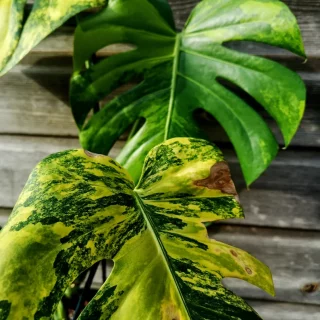
The most iconic variegated plant in the collector community. The Monstera Albo’s white and green sectored leaves are the result of chimeric mutation — meaning the variegation is inherently unstable and heavily dependent on adequate light to persist.
Light requirement: Bright indirect, minimum 1,500 lux, ideally 3,000–5,000 lux.
Best placement: 1–1.5 metres from a large east or west-facing window, or directly beside a north-facing window (southern hemisphere). A south-facing window in the northern hemisphere with a sheer curtain works well.
What happens in low light: The plant will begin producing progressively greener leaves within 2–3 growth cycles. Once a section reverts, it cannot be reversed in that leaf.
Office suitability: Only if you have floor-to-ceiling windows or are willing to supplement with a grow light. Not suitable for interior office spaces.
👉 Browse our Monstera Albo collection at variegatedplantscircle.com
Monstera Thai Constellation
The Thai Constellation is arguably the beginner-friendly alternative to the Albo. Its cream and green marbling pattern is tissue-culture stable — meaning unlike chimeric varieties, the variegation is encoded in every cell and is significantly less prone to reverting.
Light requirement: Bright indirect, 1,500–4,000 lux. Slightly more forgiving than the Albo.
Best placement: Within 1–2 metres of a bright window. Tolerates slightly less light than the Albo without reverting, but will grow considerably slower in medium light.
Office suitability: Good for offices with large windows. Tolerates the stable, consistent light of a well-lit open-plan office better than many chimeric varieties.
Monstera Mint Variegata
One of the rarest and most striking Monsteras, the Mint features pale green mint-coloured variegation rather than white. Like the Albo, it is chimeric and requires strong consistent light.
Light requirement: Bright indirect, minimum 2,000 lux. One of the more light-hungry variegated Monsteras.
Best placement: As close to a bright window as possible without direct sun. An east-facing window where it receives morning sun for 1–2 hours is ideal.
Office suitability: Only suitable for very well-lit spaces.
👉 Explore Monstera Mint Variegata at variegatedplantscircle.com
Philodendron Caramel Marble
The Caramel Marble is one of the most sought-after Philodendrons in the collector world, with extraordinary leaves that emerge in shades of copper, caramel, and cream before maturing to multi-toned green and yellow. Its variegation type falls somewhere between stable and chimeric, making it somewhat more forgiving than the most volatile varieties.
Light requirement: Bright indirect, 1,500–3,500 lux.
Best placement: Beside a bright east or west-facing window. Avoid intense afternoon sun on the pale sections.
Office suitability: Moderate. Works well in offices with generous natural light.
👉 Shop Philodendron Caramel Marble at variegatedplantscircle.com
Philodendron Billietiae Variegated
The Billietiae Variegated is a show-stopper with long, elongated leaves splashed with cream and yellow variegation. It is an aroid that handles brighter conditions well and can tolerate slightly more indirect light than compact Philodendrons.
Light requirement: Bright indirect, 1,000–3,000 lux.
Best placement: Works well near east, west, or north-facing windows. More adaptable than many collector plants.
Office suitability: Good. One of the better options for bright modern offices.
👉 Find Philodendron Billietiae Variegated at variegatedplantscircle.com
Rhaphidophora Tetrasperma Variegated (Mini Monstera)
The variegated Rhaphidophora Tetrasperma is a faster-growing, more compact alternative to the larger aroids. Its fenestrated leaves with white or green-on-green variegation make it visually striking and considerably more manageable in smaller spaces.
Light requirement: Bright indirect, 1,000–2,500 lux. One of the more adaptable variegated plants.
Best placement: 1–2 metres from a bright window. Handles slightly lower light better than Monsteras but will lose variegation speed and contrast in dim conditions.
Office suitability: Very good. Compact, fast-growing, and adaptable enough for office environments with reasonable natural light.
👉 Shop Rhaphidophora Tetrasperma at variegatedplantscircle.com
Variegated Plants for Medium Indirect Light
These varieties have stable, DNA-encoded variegation that is more tolerant of medium light conditions — though none of them should be placed in genuinely dark corners.
Scindapsus Pictus ‘Exotica’ / ‘Argyraeus’
The Scindapsus Pictus is one of the most overlooked variegated plants in the collector world. Its silver-splashed, satin-textured leaves are stunning, its variegation is extremely stable (encoded in its DNA), and it is one of the most forgiving variegated plants available.
Light requirement: 500–2,000 lux. Genuinely handles medium indirect light without losing its silver markings.
Best placement: Works at up to 3 metres from a bright window. Tolerates north-facing rooms better than almost any other collector-grade variegated plant.
Office suitability: Excellent. One of the very best options for offices with standard overhead lighting supplemented by natural light.
Aglaonema Varieties (Red, Pink, and Bicolour)
Aglaonemas are among the most light-tolerant variegated plants in existence. Their stable, DNA-encoded variegation in shades of red, pink, cream, and green holds reliably even in lower light conditions.
Light requirement: 200–1,500 lux. The most low-light tolerant genuinely variegated plants available.
Best placement: Suitable for north-facing rooms, shaded office interiors, and spaces several metres from windows.
Office suitability: Outstanding. The number one recommendation for interior offices with no direct window access.
Tradescantia Nanouk
The Tradescantia Nanouk is a patented cultivar with stunning pink, white, and green variegated foliage. Its variegation is stable and its care requirements are straightforward. The one caveat: it needs reasonable light to maintain its vivid colouring.
Light requirement: 800–2,500 lux. Needs more light than Aglaonemas to keep its pink tones vivid.
Best placement: Bright windowsill or well-lit desk near a window.
Office suitability: Good for desk placement near windows. Compact and visually impactful.
Variegated Plants for Offices with Grow Lights
If your office or home has genuinely low natural light — interior rooms, north-facing spaces in the northern hemisphere, basement studios — grow lights are the solution that lets you keep collector-grade variegated plants regardless of your natural light situation.
Recommended grow light setup:
- Full-spectrum LED grow light (Spider Farmer or similar)
- Positioned 30–60cm above the plant canopy
- Running 12–14 hours per day on a timer
- This setup replicates bright indirect light conditions for the most demanding varieties
With a proper grow light, even a Monstera Albo or Philodendron Caramel Marble can thrive in a windowless office.
Quick Reference: Light Guide by Space
| Space Type | Light Level | Best Variegated Plant Choices |
|---|---|---|
| South/west-facing living room | Bright indirect | Monstera Albo, Thai Constellation, Caramel Marble, Mint Variegata |
| East-facing bedroom | Bright indirect | Rhaphidophora Tetrasperma, Philodendron Billietiae, Monstera Albo |
| North-facing room | Medium indirect | Scindapsus Pictus, Aglaonema, Tradescantia Nanouk |
| Open-plan office (window nearby) | Bright indirect | Thai Constellation, Philodendron Billietiae, Rhaphidophora |
| Interior office (no window) | Low / grow light | Aglaonema, or any variety with grow light supplementation |
| Home studio / apartment | Variable | Assess with Photone app, then choose accordingly |
5 Mistakes to Avoid When Buying Variegated Plants for Your Space
1. Trusting “tolerates low light” labels on rare varieties This is often written by retailers who want to sell plants, not by horticulturists. Chimeric variegated plants like Monstera Albo simply do not tolerate low light long-term.
2. Buying a chimeric variety for a dark corner If you love a Monstera Albo but your space is genuinely dim, either invest in a grow light or choose a tissue-culture stable variety like the Thai Constellation instead.
3. Placing plants in direct afternoon sun The white and cream sections of variegated leaves are delicate. Direct afternoon sun will scorch them within days, leaving permanent brown patches that no amount of care will reverse.
4. Not accounting for seasonal light changes A spot that has bright indirect light in summer may drop to medium or low light in winter as the sun angle changes. Plan for your worst-case light scenario, not your best.
5. Judging light by how bright it seems to your eyes Human eyes adapt to light levels extraordinarily well — a space that feels bright to you may read at only 500 lux on a light meter. Always measure.
The Bottom Line
The right variegated plant for your space is the one that matches your actual light conditions — not the one you want most. The good news is that the variegated plant world is vast enough that there is a stunning option for every environment, from sun-drenched conservatories to windowless offices.
Start by measuring your light with the Photone app. Then match your conditions to the plants above. If your heart is set on a chimeric variety like the Monstera Albo but your light is limited, invest in a quality grow light — it’s a fraction of the cost of the plant itself and will protect your investment for years.
Ready to find your perfect match? Explore our full collection of rare variegated plants — all shipped worldwide with phytosanitary certification and a 30-day live arrival guarantee.
👉 Browse the full variegated plant collection at variegatedplantscircle.com
Frequently Asked Questions
Can variegated plants survive in an office with no windows? With a quality full-spectrum grow light running 12–14 hours per day, yes. Without supplemental lighting, only Aglaonema varieties have a realistic chance of long-term survival.
Which variegated plant needs the least light? Aglaonema varieties are the most light-tolerant genuinely variegated plants. Scindapsus Pictus is a close second and offers a more “collector” aesthetic.
Will my Monstera Albo revert if I move it to a darker spot? Likely yes, over time. Chimeric varieties like the Monstera Albo are highly responsive to light levels. A few weeks in lower light may not cause immediate reversion, but prolonged reduced light almost always triggers greener growth.
How do I know if my plant is reverting due to low light vs. natural variation? If two or more consecutive new leaves are substantially greener than previous growth, reversion is underway. Move the plant to brighter conditions immediately and prune back to the last variegated node.
Does the Monstera Thai Constellation need as much light as the Albo? No. The Thai Constellation’s tissue-culture stable variegation is more forgiving and will persist in slightly lower light conditions than the chimeric Albo — though it still needs bright indirect light to thrive.
For more plant care guides, visit our blog at variegatedplantscircle.com · Questions? Contact us here · Email: sales@variegatedplantscircle.com
